Problem: How can we represent 3D rotations mathematically and how can we compose them?
3D Objects
In graphics & physics we represent 3D objects in various Coordinate Systems, namely the global coordinate system and an objects’ local coordinate system:
- Global: has a fixed origin and is static irregardless of the movement of objects in the space
- Local: is relative to the position and orientation of the object. An object is always located at the origin of it’s own local coordinate system
So to represent any object (in either coordinate system) all we need to know is its position and orientation and a way to map between coordinate systems
- position we can easily represent via a vector $x \in \mathbb R^3$ representing an objects’ Center of Mass (CoM)
- How to represent orientation? -> some mystery element R in some space?
- We want to compose rotations over time -> we are looking for a space + operator (a Group1) representative of 3D rotations
For now we will ignore the other physical properties of these objects such as their size, weight, etc
What is a Rotation
Use this digital model to reason about the concepts below (or a physical object near you)
Interactive sphere with axis-angle rotation controls: three sliders set where a red dot points on the sphere, normalized to a unit vector, and a fourth slider rotates the sphere by a chosen angle about that axis. The dot stays fixed while the rest of the sphere spins around it.
- After a rotation, dimensions are exactly the same. There’s no twisting, shearing, or scaling (Known as a “rigid” transformation or isometry)
- Degrees of Freedom2 of a rotation:
- Can we achieve any orientation of the sphere by pointing the red dot?
- Note: this is a unit vector in $\mathbb R^3$ with 2 DoFs, we have full freedom of x and y but then z is determined s.t. magnitude = 1 - Notice that even if we fix the direction of this dot, we can still rotate by any angle $\theta$ about this direction - so we this is another DoF and we see that any 3D rotation has 3 DoFs
- Rotations are NOT Commutative
- this is illustrated via the graphic above
- Rotations are NOT reflections
- reflections change the handedness of a space
- We can think of this as a spatial inversion, effectively changing up -> down, left -> right in the POV of the 3D object
- fun way to think of this is that we don’t want our rotation operation to send our object into the mirror dimension as seen in Dr. Strange
Rotation Matrices from Scratch
Using the context and definitions above we can now come up with a representation
Rotation as a “rigid transformation”
A rotation is a transformation on a coordinate space, it maps from 3D -> 3D so we are looking for a space of matrices in $\mathbb R^{3\times 3}$
- Matrix multiplication represents a linear transformation AND it’s non-commutative ✅ Ensuring “rigidity” of the transformation:
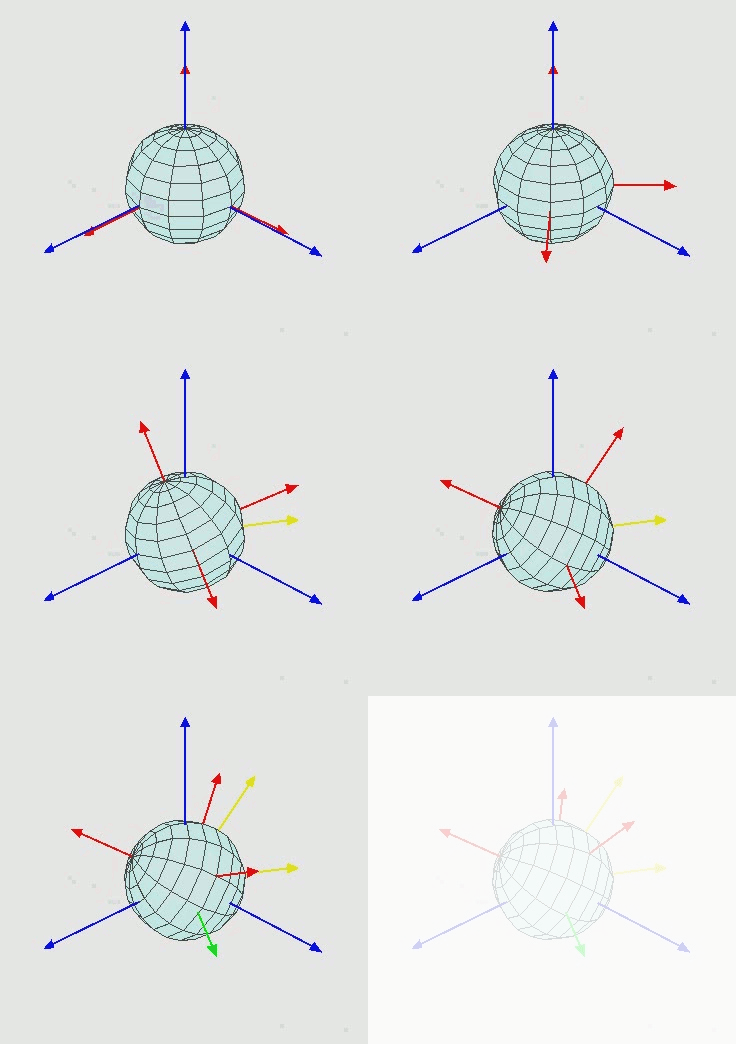
- In above animation we are applying rotation R to object starting with standard basis I. Notice that new coordinate system $RI=R$ is also an orthonormal basis
If we know that columns of R form an orthonormal basis set (aka R is an orthogonal matrix) it has the special property: \(R^T R = RR^T = I\)
- This equation also reinforces the fact that rotations only have 3 Degrees of Freedom, it represents 6 constraints3 so the DoF of the rotation matrices is 9 - 6 = 3 ✅
Excluding reflections
By enforcing just one constraint (namely $R^{-1} = R^T$) we have satisfied all but one requirement for representing rotations. However, we have yet to distinguish our representation for rotations apart from reflections!
Recall: The unique property of reflections in that they “invert” the space. We need a constraint that identifies and disallows this.
I’d like to draw your attention to the Determinant to accomplish this.
- The determinant tells us how a linear transformation scales and compresses space by calculating the signed volume of the unit cube post-transformation
- If the determinant is > 1 then the transformation stretches space
- if it’s 0 then it collapses space into a lower dimension
- If the determinant is negative, then this means that it inverted space and thus we can identify linear transformations that encode reflections
Applying the determinant to our previous constraint: \(\det(R^TR) = \det(I) = 1 \implies \det(R)^2 = 1 \implies \det(R) = \pm 1\) As we can see via the determinant it does enforce rigidity of transformation since space is neither stretched nor compressed, however we need to be specific to exclude reflections by adding another constraint: \(\det(R) = 1\)
Summary
Thus we have deduced two simple constraints that allow us to represent rotations as 3 by 3 matrices
-
Orthogonal \(R^T R = I\)
-
Preserve Handedness \(\det(R) = 1\)
This representation allows efficient composition via matrix multiplication.
The set of all matrices in $\mathbb R^{3 \times 3}$ that follow these rules are known as the Special Orthogonal Group or SO(3). This is a smooth manifold embedded in the space of 3 by 3 matrices (we will discuss smooth manifolds and take advantage of this property in a later article)
Next time we will discuss the problems of this representation and work our way to the more natural (but less intuitive) representation: quaternions
-
A group $(G, \cdot)$ is a set of elements together with a binary operation $\cdot$ that is closed, associative, has an identity element, and gives every element an inverse. Rotation composition has all of these — which is exactly why 3D rotations form a group. ↩
-
Degrees of freedom (DoF) are the number of independent parameters needed to fully describe a configuration. A unit vector in $\mathbb R^3$ has 2 DoF (position on the sphere), and the freedom to spin about it adds a 3rd. ↩
-
The six constraints come from $R^T R = I$: the three diagonal entries of $R^T R$ must equal $1$, and the three above-diagonal (equivalently below-diagonal) entries must equal $0$. ↩